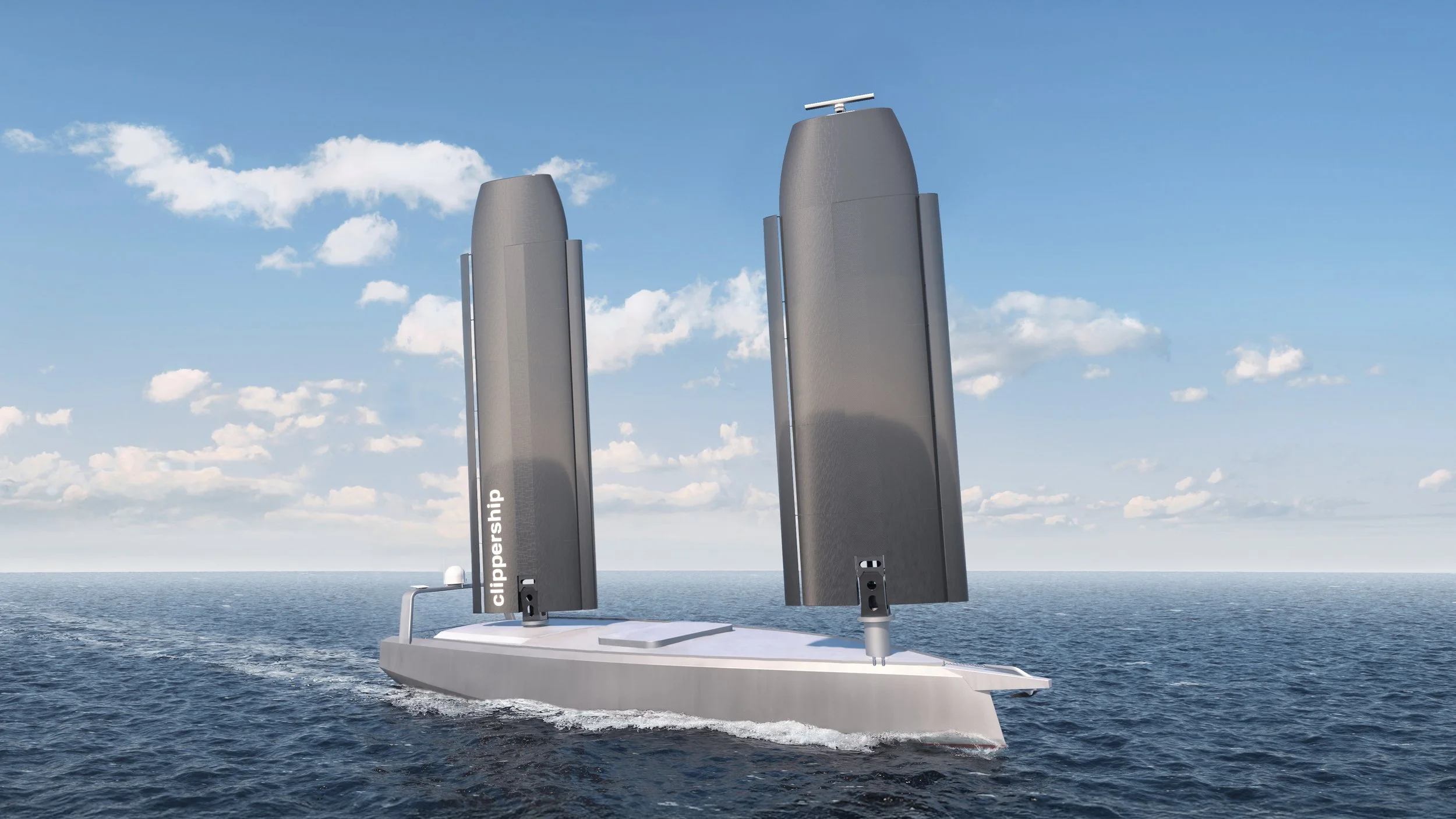
Our autonomous vessels move cargo by wind power.
Efficiently. Sustainably. And cost-effectively.
Clippership’s compact ships move palletized cargo across the ocean on optimized point-to-point routes. Our alternative to traditional shipping reduces costs, shrinks warehouse-to-warehouse transit times, and boosts supply chain resiliency – while dramatically cutting carbon emissions.
-
Conventional large ships can only reach a limited number of deepwater ports, which adds significant ground transport costs in getting goods from producers to consumers. By harnessing wind power while reducing (and eventually eliminating) onboard crew, Clippership can operate economically between smaller ports that are closer to where products came from and where they need to be.
-
With traditional container shipping, you have very little flexibility; sending smaller shipments means dealing with the complexity and uncertainty of consolidation services – or paying a premium for deferred air freight. Clippership’s solutions are designed to take full advantage of nimbler, more cost-effective pallet-based logistics.
-
On heavily traveled large-ship routes, capex can approach $1B per trade lane. Clippership establishes low-volume point-to-point routes at a fraction of the cost. Your supply chains gain added resilience from a distributed, democratized transoceanic network that’s immune to single-point failure.
Our Method
P1
Phased-in Autonomy
Steadily improving performance and reducing opex
As we introduce our first Clippership cargo vessels, we continuously monitor and evaluate the performance of onboard systems, using the data we gather to design improvements that will deliver even better performance — and ensure compliance with the emerging Maritime Autonomous Surface Ships (MASS) Code of the International Maritime Organization. Our initial 24-meter cargo vessel is fully autonomous, requiring minimal supervision from onboard mariners. We’ll be evolving to uncrewed voyages with remotely monitored autonomy as the platform matures and MASS regulations are adopted globally.
P2
Optimized Vessel Size
Increasing capacity while avoiding large-port friction
We’re launching our 24-meter vessel in 2026 to demonstrate the feasibility and value of our sustainable shipping solutions. The vessel’s optimized 75-pallet capacity and ultra-low opex makes transoceanic shipping economical even for relatively small cargo volumes. And its unique design takes advantage of the higher throughput enabled by streamlined port operations at Clippership’s bonded terminal facilities. We’re applying the insights gained in designing and deploying the 24-meter vessel to further evolve and enhance our vessel development pipeline. Next, we’ll be producing a 48-meter version with a 400-pallet cargo capacity and automated pallet handling.
P3
Maritime network effect
Adding vessels and terminals to strengthen the total system
Clippership moves palletized cargo quickly and cost-efficiently without the large infrastructure required by ISO containerized shipping. And the low capex per vessel is allowing us to invest rapidly in creating new point-to point-routes — with each additional vessel and terminal amplifying overall network performance.
PARTNERS